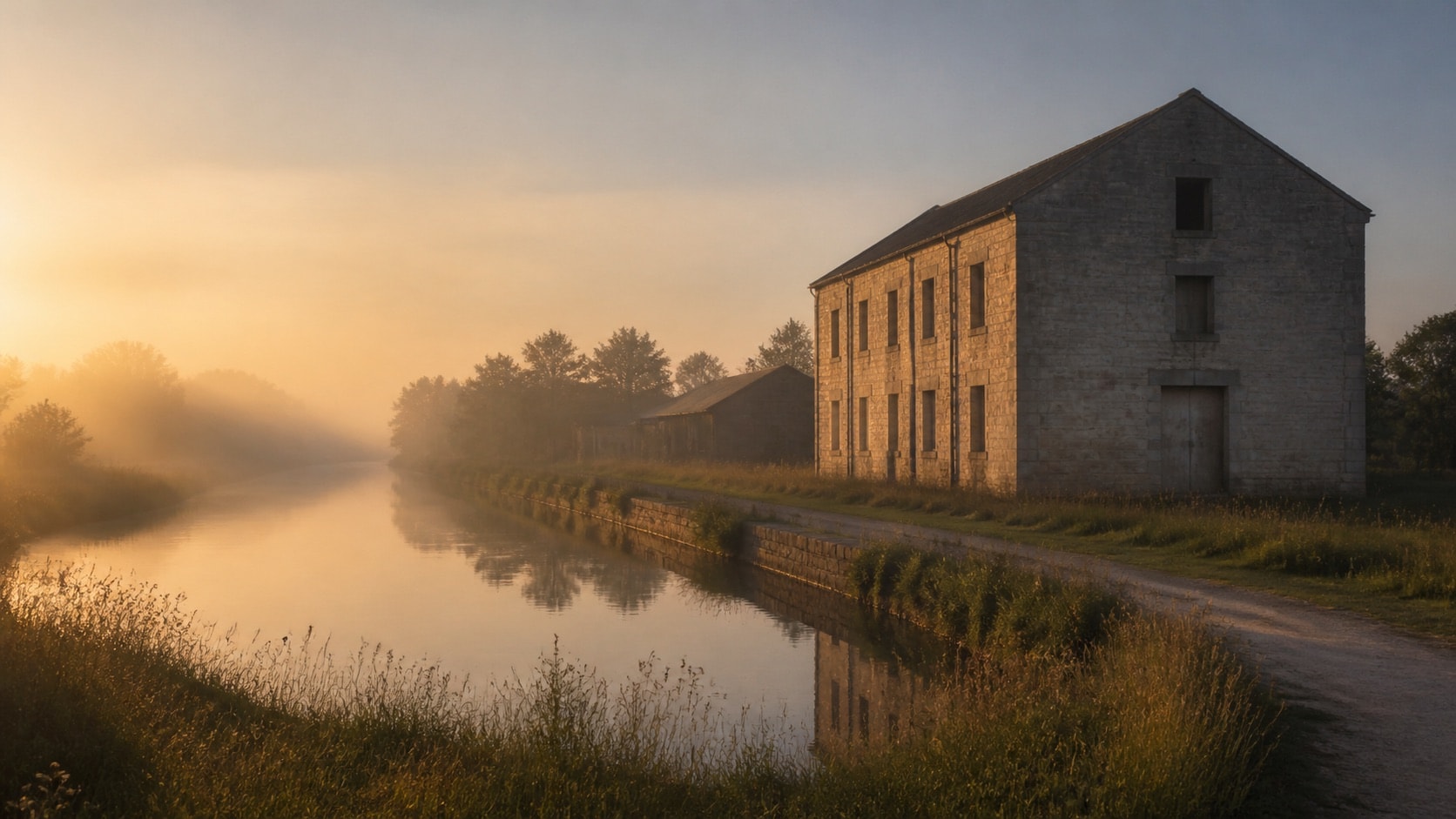
A county shaped by movement
LaSalle County can be read as a meeting place: river and prairie, footpath and towpath, farm and factory, household and public archive.
The subjects gathered here include a canal warehouse, a one-room school, blacksmithing, agriculture and a long-running community food tradition. This is a reading room, not a visitor desk. It does not publish current hours, take registrations, accept donations or speak for the current museum organization. Instead, each page asks what a structure or practice can reveal when it is placed in a wider historical frame.
Movement provides one way to connect these subjects without pretending they tell a single story. Water routes carried freight; roads and paths joined buildings to fields; tools moved force through wood, soil and iron. The working landscape of farm tools, bodies and seasons makes those connections especially clear. An implement belongs not only to a task but also to a calendar of preparation, use, repair and storage. Its wear may suggest repeated action, while an account book may place that action within purchases or hired work. Neither source is complete alone. Following material from landscape to workshop and warehouse also reveals where evidence changes scale: a mark on a handle, a repaired fitting and a loading doorway can belong to one economy without sharing one owner or date. The aim is not to close those gaps through imagination, but to state which connection is documented, which is a reasonable interpretation and which remains a question.
The National Park Service history of the Illinois and Michigan Canal explains why transportation is the best place to begin. Opened in 1848, the waterway connected the Great Lakes system with the Illinois River and, beyond it, the Mississippi watershed. It moved grain, stone, timber, manufactured goods and people. The canal did more than shorten a journey: it redirected settlement, investment and labor across the region. Towns along the route became points where national change was experienced at the scale of a warehouse door or a towpath bridge.
Buildings as working documents
A historic building is not simply a container for stories. Its walls, floor loads, doors and later repairs are evidence. A sandstone warehouse beside a canal records expectations about heavy freight and fire resistance. A compact schoolroom records how one teacher organized many ages in a shared space. A forge preserves the relationship between heat, skill and the repair needs of an agricultural community. A timber barn reveals the dimensions of equipment and the rhythm of seasonal work.
This material approach also encourages caution. A picturesque building can tempt a writer to smooth the past into nostalgia. Yet every working structure was shaped by difficult choices: who controlled land, whose labor was counted, what hazards were accepted, which objects were saved and which were discarded. These pages distinguish between a documented fact, a reasonable interpretation and a question still open to research. That distinction is the basis of responsible local history.
Landscape
Follow the canal and river to understand how geography became infrastructure.
Labor
Read tools and buildings as traces of skilled, repeated and often invisible work.
Memory
Test family stories and traditions against records without flattening their meaning.
From an object to a larger question
Good local-history research often begins with an ordinary thing: a clock, school ledger, horseshoe, kitchen vessel, photograph or parcel map. The object supplies clues about materials, makers, owners and use. A researcher then moves outward. County records may establish dates. Trade catalogs can identify a tool form. Newspapers can reveal how an event was described at the time. Census schedules place an occupation in a household. Maps show whether a road, rail line or canal basin was nearby.
The Library of Congress lesson on creating a local primary-source archive offers a useful principle: community materials matter because they connect personal experience with state and national change. The same principle works for adult researchers. A family photograph becomes stronger evidence when its buildings, clothing and inscriptions are compared with independent sources. A recollection remains valuable even when details shift, provided the researcher records who told it, when and under what circumstances.
A route through local history
Begin with the canal overview, then step inside the warehouse to consider commercial architecture. The one-room school and blacksmith shop move closer to daily routines. Agricultural history follows tools into the field, while Burgoo and community foodways examines how repeated gatherings turn practice into tradition. Finally, the research guide sets out a source-checking method for pursuing questions beyond this site.
Scope note: Claims about regional history are linked to public institutions where possible. Current museum operations belong to the successor site named in the independence notice.